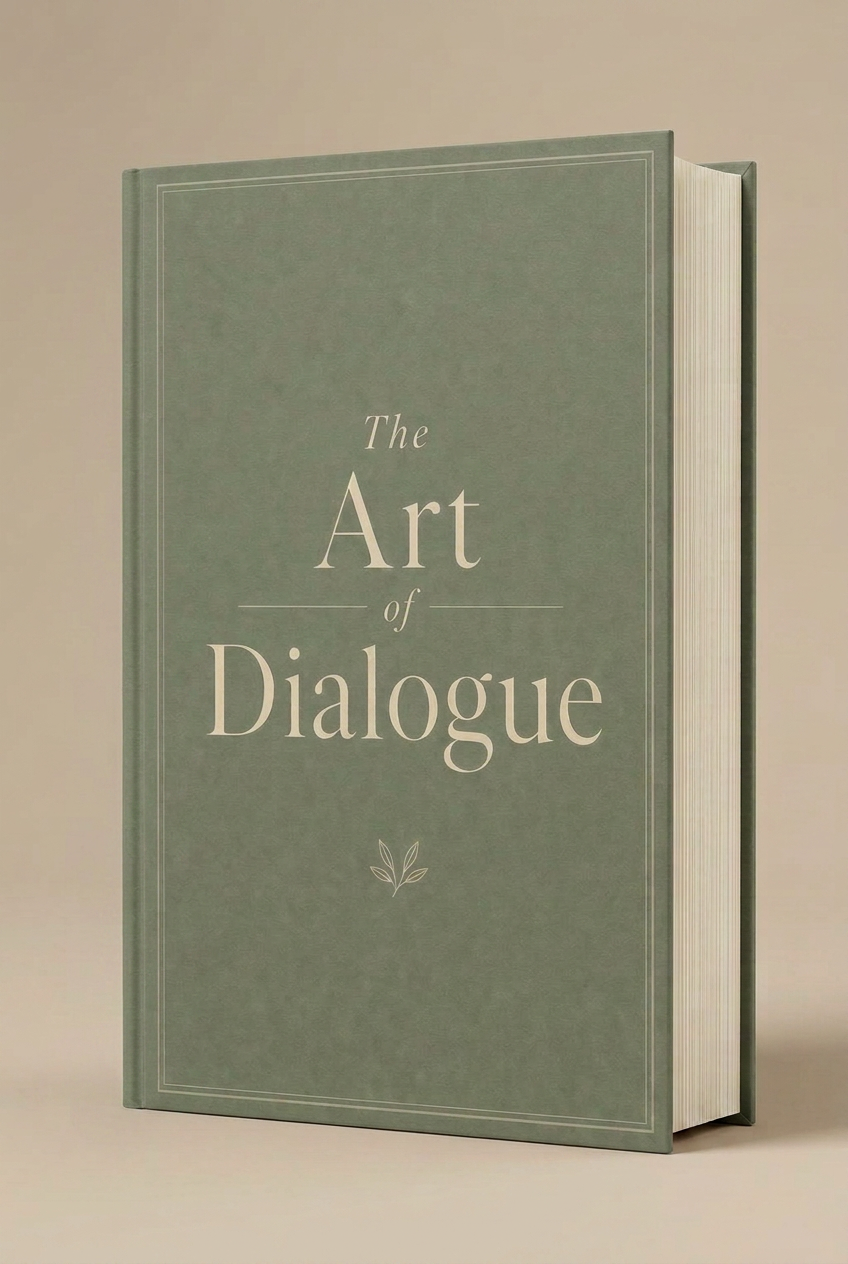
The Art of Dialogue · A Relationship Library volume
Say the hard thing. Protect the relationship.
Most people avoid difficult conversations because they fear saying the wrong thing. This 3-question framework prepares you in under 15 minutes so you can speak clearly, stay calm, and keep what matters intact.
Used by managers, parents, and client-facing professionals in 12+ countries.

The core problem
Why your brain shuts down right when you need it most.
You have prepared what you want to say. You know the conversation needs to happen. Then the moment arrives, and your mind goes blank. You either freeze, say something you regret, or avoid it entirely. Again. Most people assume this means they are bad at communication. They are wrong.
Here is what is actually happening: when a conversation feels high-stakes, your brain treats it like a physical threat. It triggers the same survival response as if you were in danger. The part of your brain responsible for logic, empathy, and clear thinking gets cut off. What takes over instead is the part wired for fight, flight, or freeze. This is not a character flaw. It is biology. And it happens to almost everyone.
So when you get defensive, shut down, or say something that makes things worse, it is not because you are weak or bad at relationships. It is because you walked into a tense moment with no structure to hold onto. Without a simple plan, your brain defaults to survival mode. And survival mode does not care about preserving your relationship or your reputation. It just wants out.
The opportunity
A simple framework that keeps your brain in the room.
The Art of Dialogue is built around one core idea: you do not need the perfect words. You need a clear structure. The 3-question P.A.R. framework, Prepare, Act, Repair, gives your mind a track to run on before and during any difficult conversation. It takes under 15 minutes to use. And it works at work and at home.
What makes it different from every book, course, or piece of advice you have tried before is this: it does not give you a script. Scripts fail the moment the other person goes off-track. Instead, this framework organizes your own thoughts, clarifies your real goal, and gives you a pre-planned way to recover if things get tense. It works with how your brain actually functions under pressure, not against it.
Picture walking into that conversation you have been putting off for weeks. You are not rehearsing lines in your head. You are not dreading it. You know what you want to say, why you are saying it, and exactly what to do if it starts to go sideways. The issue gets addressed. The relationship stays intact. And you walk away feeling like someone who handles things, not someone who avoids them.
Who this is for
Built for people who need to say the hard thing without losing the relationship.
Managers and Team Leads
You need to give honest feedback, address poor performance, or handle conflict on your team, but you keep putting it off because you are not sure how to say it without making things worse.
Partners and Parents
Sensitive topics at home keep getting postponed. Finances, boundaries, unspoken tension, you know the conversation needs to happen, but the fear of a fight keeps stopping you.
Client-Facing Professionals
You deal with scope creep, missed expectations, or difficult clients, and saying something feels risky. You need a calm, clear way to address it without damaging the relationship.
What changes
Four things that change when you have a framework for hard talks.
Prepare in under 15 minutes
No more spending days dreading a conversation. The 3-question framework gets your mind clear and focused before you walk in, so you know exactly what you want to say, and why.
Stop freezing under pressure
When the conversation gets tense, your brain wants to shut down. The P.A.R. Protocol gives it a simple track to run on, so you stay calm, clear, and in control, even when emotions run high.
Open without starting a fight
Most conversations go sideways in the first 30 seconds. The Conversation Compass shows you how to open a sensitive topic in a way that invites the other person in, instead of putting them on the defensive.
Repair it before it breaks
Even well-prepared talks can get tense. The De-escalation Toolkit gives you a clear, pre-planned way to pause, reset, and bring the conversation back, so one heated moment does not cost you the relationship.
Readers' words
Real people. Real conversations. Real results.
"I finally had the talk I had been avoiding for three months. It went better than I ever expected, and we actually solved the problem."
"I used to freeze the moment things got tense. Now I have a plan for that moment. It changed everything at work and at home."
WHAT WE NOTICED
Why this exists and why it took longer than it should have.
We kept hearing the same thing from people: it's not that they're bad at conflict, it just feels that way.
They'd see a problem coming, at work and at home, and tell themselves they'd handle it soon. Then soon became later. Later became never. And the thing they were avoiding didn't disappear. It just got heavier. They'd read the books. Tried the "I feel" statements. Sat through the corporate workshops. None of it worked when it was actually needed. The moment the conversation got real, the moment they could feel the other person tense up, everything they had learned went blank. They would either shut down completely or say something they immediately regretted. The advice wasn't wrong. It just had no place to live when the pressure was on.
The shift came from a single question: what if the problem was not me, but the fact that I had no structure to hold onto when my brain went into survival mode?
That question led to everything. It started with studying what actually happens in the brain during a high-stakes conversation, the amygdala, the part of the brain that treats a difficult talk the same way it treats a physical threat. Freezing and getting defensive isn't a character flaw. It's biology. And biology can be worked with.
From that insight came a simple 3-question framework: one question to prepare, one to open, one to repair. Tested. Refined. Used in real conversations that mattered. The result is The Art of Dialogue: a practical, repeatable system that gives your mind a clear track to run on, even when the stakes feel personal and the pressure is real. Not a script. Not a theory. A framework you can use in under 15 minutes, at work and at home.
How it works
Three clear steps. One repeatable process.
Every difficult conversation, handled. The P.A.R. Protocol is simple enough to use at work and at home, starting with your very next conversation.
- 01
Prepare — Get Clear Before You Speak
Before you say a word, you use one targeted question to identify the real issue and your desired outcome. It cuts through emotional noise and gets you ready in under 15 minutes. You stop guessing what to say. You know exactly what you want from the conversation before it starts.
- 02
Act — Open Without Triggering Defensiveness
You use a second question to open the conversation in a way that invites the other person in, rather than putting them on guard. It sets a collaborative tone from the first sentence and signals safety to both brains, so logic stays on. This is the difference between starting a dialogue and starting a fight.
- 03
Repair — Recover When It Gets Tense
When the conversation starts to tighten up, you use a third question to pause, reset, and bring it back to a productive path. It de-escalates before it becomes an argument and protects the relationship even when emotions run high. This is your safety net.
The investment
Everything you need to handle your next difficult conversation.
The Offer
The Art of Dialogue
- ✓The Art of Dialogue
- ✓Dialogue Code — Preparation Protocol: The Three-Question Framework
- ✓Dialogue Code — Conversation Compass: Word-for-Word Openings
- ✓Dialogue Code — De-Escalation Toolkit: Phrases to Repair the Moment
- ✓Instant Digital Access
Start reading in the next five minutes - ✓60-Day Conversational Breakthrough Guarantee
The Offer
Complete System
- ✓The Art of Dialogue
- ✓Dialogue Code — Preparation Protocol: The Three-Question Framework
- ✓Dialogue Code — Conversation Compass: Word-for-Word Openings
- ✓Dialogue Code — De-Escalation Toolkit: Phrases to Repair the Moment
- ✓Instant Digital Access
Start reading in the next five minutes - ✓60-Day Conversational Breakthrough Guarantee
Included Bonuses
- ★Bonus #1: Real-World Scenarios Playbook
- ★Bonus #2: Calm in Chaos Cue Card
- ★Bonus #3: The Unreasonable Person Protocol
- ★Bonus #4: Private Community Access
Less than the cost of a single coaching session. Get the complete system for just $67.
YES, I WANT THE COMPLETE SYSTEM- ✓ Secure Checkout
- ✓ Instant Access
- ✓ 60-Day Money-Back Guarantee
Our guarantee
Use it once. If it does not work, you pay nothing.
Get The Art of Dialogue. Read it. Use the 3-question framework in your next difficult conversation at work, at home, wherever you need it most.
If you do not feel a clear increase in your confidence going into that conversation... if it does not go more smoothly than before... simply email us within 60 days.
You get a full refund. Every dollar back. And you keep the ebook and every bonus. No questions. No conditions. No hard feelings.
This guarantee exists because the framework works. Not in theory but in real conversations, with real people, under real pressure. The risk is entirely ours.
You have nothing to lose and one very important conversation to gain.
The future vision
One decision. Two very different lives.
Picture this.
You get a message from your manager asking to meet tomorrow. A month ago, that would have sent you into a spiral of dread.
Not anymore.
You spend 15 minutes with the framework. You get clear on what you want to say. You walk in calm. You say it clearly. The conversation goes well. You leave feeling like yourself.
That is what changes first: the anxiety goes quiet.
Then the bigger things shift. Your team starts to respect you more. Not because you got louder. But because you got clearer. Feedback that used to sit unsaid for weeks now gets handled early, before it becomes a problem.
At home, the conversations you used to postpone for months... You have them. Calmly. Your partner feels heard. You feel heard. The tension that used to just sit there, quietly poisoning things, starts to lift.
You become the person others come to when they don't know how to handle something. Not because you have all the answers. But because you know how to talk through the hard stuff without making it worse.
That is the version of you that is one conversation away.
Now consider the other path
Nothing changes.
The conversation you need to have at work stays unsaid. The issue festers. Your manager starts to wonder if you can handle the role. The promotion goes to someone else.
At home, the same topics keep getting avoided. The same tension keeps building. The relationship slowly hollows out, not from a single fight, but from a thousand things left unsaid.
And the worst part? You already know this is happening. You have known for a while.
The problem is not that you lack the words. The problem is that no one ever gave you a structure that works when the pressure is real and your brain wants to shut down. That structure exists now. The only question is whether you use it.
Last concerns
Still on the fence? That makes sense.
"My situation is too complicated for a simple 3-question framework."
That feeling is real, and it makes sense. But the complexity in your situation is emotional, not logical. And that is exactly why you need something simple. When the pressure is on, your brain cannot access complex systems. It needs a clear track to run on. The framework does not oversimplify your situation; it cuts through the noise so you can focus on what actually matters in that conversation.
"What if I try this and it still does not work?"
Then you pay nothing. The Conversational Breakthrough guarantee gives you 60 days to apply the framework in a real conversation. If you do not feel more confident and clear, email us. Full refund. You keep the ebook and all the bonuses either way. There is no scenario where you lose.
"If I use a technique, I will sound robotic and fake."
This is one of the most common concerns and the most understandable one. But this framework is not a script. It does not tell you what to say. It helps you get clear on what you actually think and want before you open your mouth. What comes out is still you. Just a calmer, clearer version of you without the panic.
"The other person is the real problem. They never listen."
You are probably right that they can be difficult. But what we often call 'unreasonable' is actually a defensive reaction to how the conversation starts. A disorganized or accusatory opening almost guarantees a defensive response. The framework gives you a way to open that lowers their guard from the first sentence. There is also a full bonus dedicated to exactly this: The 'Unreasonable Person' Protocol.
"I do not have time to read a whole book right now."
You do not need to. The core framework takes under 90 minutes to read and understand. The 'Calm in the Chaos' Cue Cards give you the key steps on a single reference you can keep nearby. You can be ready for your next difficult conversation before the end of today.
60-Day Money-Back Guarantee
FAQ
Frequently asked questions.
Is this a script I have to memorize and recite word for word?+
No. It is a framework for your own thinking, not a script. What you say will still sound like you, just clearer and calmer.
What if the other person is completely unreasonable?+
You cannot control them. But you can control how you open the conversation. A calm, structured opening lowers their defensiveness before it starts.
How long does it take to prepare using this framework?+
Under 15 minutes. You answer three questions, get clear on your goal, and walk in ready — not anxious.
What if the conversation goes sideways anyway?+
That is exactly what the repair sequence is for. It gives you a clear way to pause, reset, and guide things back before they spiral.
Will this work for personal conversations, not just work situations?+
Yes. The framework is designed for both. Whether it is your partner, your boss, or a difficult client, the same three questions apply.
I have tried communication advice before and it never worked. Why is this different?+
Most advice is too abstract or too scripted. This is a simple, repeatable structure you can use in any situation without sounding like an HR manual.
What exactly do I get when I purchase?+
You get the core ebook plus three bonuses: the Real-World Scenarios Playbook, the Calm in the Chaos Cue Cards, and the Unreasonable Person Protocol.
What is your guarantee?+
Use the framework in your next difficult conversation. If you do not feel more confident and clear, email within 60 days for a full refund and you keep everything.
How long until I see results?+
Most people feel the difference in their very first conversation. Full confidence with the method typically builds within 30 days of applying it.
Is $20 really worth it for an ebook?+
One mishandled conversation at work can cost you a client, a promotion, or a key relationship. A single communication coach session runs $100–$500. This framework helps you protect all three for a fraction of that.
Note: the "Unreasonable Person" Protocol bonus is only available through this Friday at midnight.